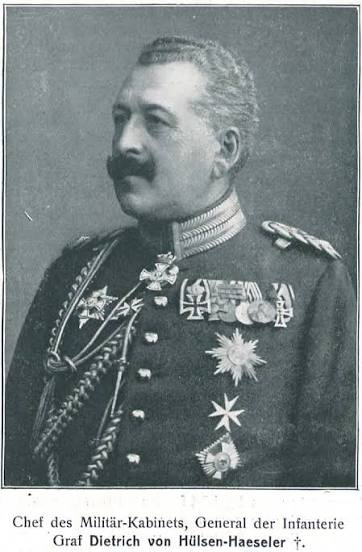
 Dietrich Graf von Hülsen-Haeseler (February 13, 1852 – November 14, 1908) was a prominent Prussian General of Infantry who served as Chief of the German Imperial Military
Cabinet under Kaiser Wilhelm II.
Dietrich Graf von Hülsen-Haeseler (February 13, 1852 – November 14, 1908) was a prominent Prussian General of Infantry who served as Chief of the German Imperial Military
Cabinet under Kaiser Wilhelm II.Queer Places:
Donaueschingen Castle, Fürstenbergstraße 2, 78166 Donaueschingen, Germany
Invalidenfriedhof, Scharnhorststraße 31, 10115 Berlin, Germany
Dietrich Graf von Hülsen-Haeseler (February 13, 1852 – November 14, 1908) was a prominent Prussian General of Infantry who served as Chief of the German Imperial Military
Cabinet under Kaiser Wilhelm II.
Born in Berlin to Botho von Hülsen (General Intendant of the Royal Theatre) and Countess Haeseler.
He joined the Prussian military in 1870 and served in the Franco-Prussian War.
He attended the War College and joined the German General Staff in 1882. Having known Kaiser Wilhelm II since childhood, he was named aide-de-camp to the Emperor in 1889.
After serving as military attaché in Vienna (1894) and commanding various Guard regiments, he was appointed Chief of the Imperial Military Cabinet in May 1901. In this role, he controlled military personnel decisions and held immense influence as one of the Kaiser's closest political and military advisers.
On the evening of November 14, 1908, von Hülsen-Haeseler was attending an imperial hunting party hosted by Prince Max von Fürstenberg at Donaueschingen Castle in Baden.
To entertain the Emperor and assembled guests following dinner, the 56-year-old general performed a cabaret routine:
He emerged dressed in a pink tutu, rose garland/wreath, and ballet slippers.
He performed a ballet dance complete with pirouettes, leaps, and flirtatious kisses toward the audience.
Upon completing his dance and bowing to applause, he collapsed from a massive heart attack. Medical attention was rushed to him, but he died at the scene.
The incident occurred at a time when Imperial Germany was engulfed in the Harden–Eulenburg Affair (1907–1909), the largest homosexuality-related political scandal of the era.
Journalist Maximilian Harden had publicly exposed several high-ranking members of Wilhelm II’s court—most notably Prince Philipp zu Eulenburg and General Kuno von Moltke—accusing them of homosexual relationships. The group was derogatorily dubbed the Liebenberg Circle. Because Paragraph 175 of the German Criminal Code criminalized homosexual acts, these public accusations triggered court-martial trials, libel suits, and intense sensationalism.
As Chief of the Military Cabinet, von Hülsen-Haeseler was responsible for managing the reputation of the Prussian officer corps. Prior to his death, he actively organized cover-ups of homosexual scandals and forced military resignations behind closed doors to shield the army and the monarchy from public dishonor. Ironically, his brother, Georg von Hülsen-Haeseler (intendant of the Royal Theatre), was also implicated in rumors during the affair.
When von Hülsen-Haeseler dropped dead in a pink dress, the imperial retinue panicked. Fearing that news of a top general dying in women's clothing while cross-dressing would be seized upon by the press as further "evidence" of rampant homosexuality in the Kaiser's inner circle, the military corps immediately swept the details under the rug: His body was quickly dressed back into his formal military uniform before authorities and the press were notified.
The official cause of death reported to the public was listed as a "sudden heart attack" or "nervous breakdown" following a strenuous hunt, completely scrubbing the cross-dressing cabaret performance from official records.
References:
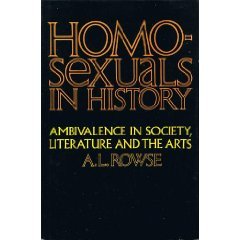 Homosexuals in History, A Study of Ambivalence in Society, Literature and the Arts, 1977 by A.L. Rowse |
Other references:
Support this project
This website is a passion project researched, developed, and funded entirely by me. If you find the content valuable and would like to help support the ongoing research and hosting costs, any contribution is deeply appreciated.
Thank you for keeping this independent resource alive!
My books on Amazon: Elisa Rolle's books